RONCHI
The Slit/Grating
mode.
Shows simple arrangement using a slit and grating.
Copyright – P. J.
Smith
But permission is
given to distribute this material in unaltered form as long as it is not sold
for profit.
GOTO RONCHI
INDEX
General
In contrast to the
Grating/Grating mode, the Slit/Grating arrangement performs well in all but a few
non- linear tests. (See Non Linear
Gratings for some of these strange test variations.)
In many, of course, the
Grating/Grating mode is a possible alternative. (See Grating/Grating mode).
Before deciding on the
source, consider the type of grating you will use. For performance comparisons see Slit V Grating performance.
A slit is an excellent choice
and in nearly all cases is my preferred option as it works well with any
grating.
The light source
Line source
An incandescent source with
a filament arranged in a line is an obvious choice and it does work well behind
a diffuser. This is probably best if
you want really intense illumination.
For sheer brute force a 12 V Quartz Iodide headlight bulb is hard to
beat but is seldom needed unless many unsilvered surface are in the test beam. Excess heat may be a problem[1].
A simple, perfectly adequate
light source, which will evenly illuminate a 5 mm long sli,t is a bright LED
with its collimating front lens left intact.
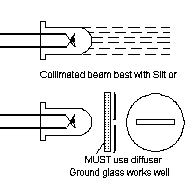
This produces an area
rather than a line source of light, but the high efficiency of a slit as
opposed to a pinhole makes this entirely adequate for visual work. A diffuser ( see Diffuser ) is placed just in front of the LED
with the slit just in front of this. The reason it is best to leave the
collimating lens surface in place on the led is because this produces more even
illumination along the length of the slit, even though a little more light may
be wasted.
LEDs of 5 and 10 mm
diameter are readily available. 5 mm is
usually sufficient and is easier to mount close to the axis but for special
cases a 10 mm one would have advantages.
A long slit is easier to locate and makes for more tolerant set-up.
The Slit
There
are a variety of ways to make a very good slit without any special
materials. Because this is the heart of
many tests and rigs, sections have been devoted to making each of the basic
types.
See
details under the Two Bladed Slit and
the Scribed Slit. The scribed slit may
have an in built diffuser.
Arrangement
The Grating is of course
mounted alongside the source. It MUST
be aligned so lines are parallel to the slit.
This is best-done while watching the Ronchi image - turning either the
slit or grating.
In its crudest form one of
these components may be mounted using modelling clay. This allows for adjustment.
A better method is suggested below.
There are a variety of
simple test rigs, which are well suited to using a Slit in conjunction with a
Grating.
The Starter and Deluxe rigs are recommended but the Basic works and the Brute
may be worth a look for special situations.
GOTO RONCHI INDEX