RONCHI
Grating/Grating mode
V
Slit/Grating
Comparison of performance of The Grating/Grating compared to the
Slit/Grating when used with different Grating materials.
GOTO RONCHI INDEX
Copyright – P. J.
Smith
But permission is given to distribute this material in
unaltered form as long as it is not sold for profit.
General
Some ATM’s seem afflicted with
a rigid view that one must use exactly the same set-up as represented by the
current fad. Ronchi testing has
successfully used a variety of set-ups over its 80 years of existence and all
are sensible candidates. The decision
on what set-up to use should be made on availability of components and
suitability to your needs – not by blindly following some suggested system.
The Grating/Grating mode
owes its popularity to a simple set-up in a community where quality gratings
are readily available. Ironically, most
seem to have forgotten that other systems also work well, are also easy to
set-up, and may be more appropriate to other situations and other communities.
I hope the following
photographs give a clear understanding of performance characteristics of the
Grating/Grating and Slit/Grating modes of operation.
Unfortunately the photos
are not ‘standardized’ in the sense that they were taken of different mirrors,
with different grating periods, and
different number of lines present. In
fact the exposures MUST be different because the slit/grating allows less light
throughput.
I would like to repeat
these with better camera equipment but I simply have no time left to do
this. Also, some of the mirrors now
don’t exist.
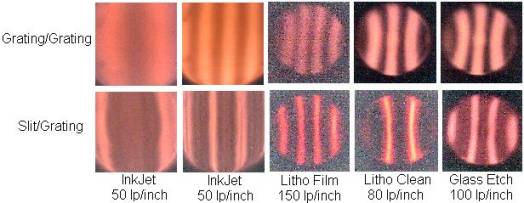
In each case comparisons may be made between the same or very similar
surfaces viewed with both the grating/grating and slit/grating mode.
The main conclusions are :-
·
Grating/Grating
mode gives wider, more diffused lines but visible detail is similar with a good
quality grating.
·
Slit/Grating
mode gives acceptable results from mediocre gratings. This is emphatically illustrated under Woven Gratings,
The
conclusion is immediately obvious. If
you want to use a Grating/Grating set-up, the grating must be excellent. But, with a lower quality grating, the
Slit/Grating mode is superior.
Explanation
Ruling accuracy
In the Grating/Grating
mode, the operation depends on the image of the grating being exactly mapped
onto itself in a perfect Ronchi test.
If not, the Ronchigram is afflicted with considerable leakage which the
Ronchigram.
Anyone who has followed
Grating manufacture will know that maintaining constant line spacing is very
difficult, especially over a large span.
Thus, any but the very best gratings give degraded images.
A grating pattern produced
on film may look contrasty, clean, and evenly spaced. But it is common to image one part of the grating onto another
portion maybe 20 mm away. Maintaining
constant spacing over a long span is the hardest thing to achieve so some
degradation often results. The
distortion of the lens producing the grating is one culprit and the linearity
of a laser or inkjet printer over a span of 20 mm is just not good enough for
best results. Used with a Slit,
however, the results are excellent.
Substrate quality
Every time light traverses
the substrate it must pass two surfaces plus the thickness of the
material. Any surface defect causes
some scattering of the light.
In the Grating/Grating mode
4 surfaces must be traversed which causes far more scattering so we would
expect optically polished glass to be far superior to a gelatine or plastic
surface. See the Inkjet grating
photographs above. With use and
exposure to the atmosphere some surfaces degrade noticeably over time. Glass is very simply the best material.
Of course, gratings made of
strands are free of this defect.
It is easy to prove that
the substrate causes degradation.
Consider the following photographs.
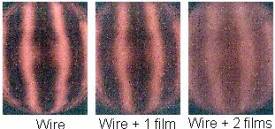
The left hand Ronchigram results from a slit and wire grating.
When 1 and 2 pieces of blank Litho film are inserted in the light path
it is easy to see the resultant degradation.
The
conclusion is obvious. Any grating made
on inferior substrate is best used in conjunction with a Slit.
Slit Width
Another
factor which should be considered when comparing performance of Grating/Grating
and Slit/Grating produced Ronchigrams is the possibility of varying the width
of the slit. Special gratings have been
made width different ratios of light to dark ( see Non Linear Gratings
) but a somewhat similar effect may be achieved by varying the slit width.
I
experimented with a quality variable spectroscope slit but its sheer size is
such that it is difficult to test close to the axis. In my opinion a variable width slit is a pleasant luxury, but it
is not necessary.
There is
more information on the effect of slit width under Diffraction.
Unfortunately,
some variation in these photographs is due to different exposures, but the
effect of varying the width of the slit is still quite obvious.

100 lp/inch using different slit widths
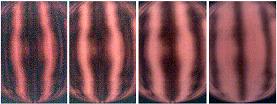
80
lp/inch using a wire grating
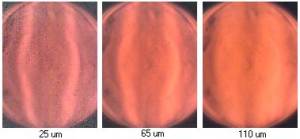
150 lp/inch
using a phase grating
If you
choose to use a slit, the most practical quick solution is, in my opinion, to
choose a scribed slit. It is easy to scribe a narrower slit. In my opinion a slit somewhat narrower than
the grating spacing is best but there is little advantage is an extremely
narrow one.
GOTO RONCHI INDEX