RONCHI
Gratings made of
woven materials
GOTO RONCHI INDEX
Copyright – P. J.
Smith
But
permission is given to distribute this material in unaltered form as long as it
is not sold for profit.
When used in
conjunction with a slit, two
dimensional woven materials produce very respectable Ronchigrams. This comes as a shock to most who have never
considered a two dimensional grating capable of producing one-dimensional
Ronchigrams. If in doubt, read on and
examine the following photographs.
Used in the grating/grating
mode they are almost useless because the linear dimensions are not
sufficiently regular. The occulting
portion of the pattern does not map the image of the source portion of the
grating. This introduces a very hazy,
unusable, Ronchigram.
If in doubt, examine
micrographs of a range of common woven materials and their Ronchigrams.
There is a huge range
of woven materials available of which the following is a small selection.
Other materials which can
work reasonably well include woven metal coffee filters, woven plastic water
filters, petrol filters material and many other cloths.
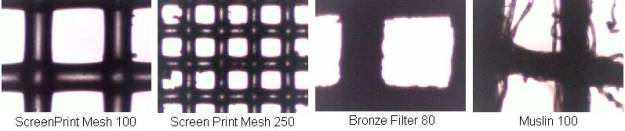
The best woven materials
are characterised by :-
(a) threads which cross without changing
direction and without noticeable bulges.
(b) threads which are a little thinner
than the space.
(c) opaque material such as metal. Others work reasonably as long as they are
used in a darkened room.
(d) regular spacing.
(e) clean threads.
(f)
In the
range of 80 to 120 threads per inch.
On this basis we would
expect materials 1 and 3 above to be best. They do in fact produce quite good
Ronchigrams.
No. 2 is too fine, has bulges,
and has reduced space dimensions. It still produces useable Ronchigrams.
No 4 is inferior but still
performs better than expected. It has
been included to show just how tolerant is this set-up.
An interesting feature of
the woven bronze wire mesh is that it may be cleaned or etched away by dipping
in Nitric acid. The best results are
from a mesh that has finer wires than spaces and is clean.
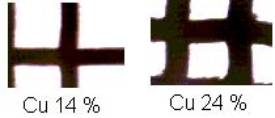
On the left is the
result of dissolving away some of the wire in Nitric acid.
Performance on an
almost perfect Sphere
with a SLIT as
source
The
makeshift gratings above were used to photograph the same sphere.
In an
attempt to allow a fair comparison between these all photographs were taken
with a cheap Webcam on automatic setting.
No image processing was performed afterwards. There is, however, some variation in exposure because the camera
is operating close to its lower limit.
For
comparison, an Edmonds etched and filled one dimensional grating was also used.
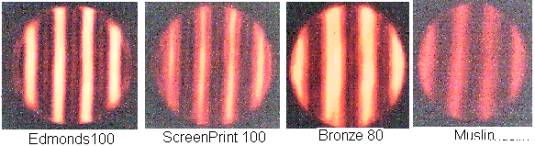
Comparison
are complicated because of the variation in light throughput of different
gratings, coupled with the limited response of the cheap camera used.
As the
percentage of obscuration in a one dimensional grating is less, its Ronchigram
is brighter and the Muslin has most obscuration as expected.
Another
problem is that the Bronze gauze used is a little coarser, which should be
allowed for.
In all
cases, including the ridiculous looking Muslin grating, the Ronchigrams are of considerable
use and the edges of the Ronchi bands are clear.
The
difference between Ronchigrams taken with the Edmonds line grating and the
woven Screen printing material is trivial.
2 D Ronchigrams.
A woven grating used either with a
·
pinhole
·
or an
identical woven grating
produces a two dimensional Ronchigram.
This is of little use to amateurs although it has been used as the basis
for a test reported in mmmmmm.
Appropriate analysis programs may extract 2D information such as
astigmatism but this is beyond ATM’s.
The Precision analysis over the entire surface in two dimensions demands
gratings precise in two dimensions so any serious implementation would discard
woven gratings in this role. They may
be replaced by two etched and filled precision linear gratings crossed at right
angles.

A typical
Ronchigram of this type is shown above.
Although this will not be of much use to amateurs, Ronchigrams of this
type may be simulated with my downloadable program “RonchiNu”.
The
Grating/Grating mode.
Woven gratings in this mode give a 2 dimensional set of crossed lines.
If these materials are used in the Grating/Grating mode the results
degenerate and are more or less unusable in contrast to with anything but the Edmonds grating.
More detail may be found under Grating/Grating
performance photographs
GOTO RONCHI INDEX