RONCHI SOURCES
The Two Bladed Slit
GOTO RONCHI INDEX
Copyright – P. J.
Smith
But
permission is given to distribute this material in unaltered form as long as it
is not sold for profit.
METAL BLADES MAKE A FINE SLIT
For a permanent set-up a slit made of
metal blades is hard to beat but remember that the Scribed Slit is easy to make and is also
quite satisfactory.
|
ADVANTAGES |
DISADVANTAGES |
|
|
|
|
Totally opaque |
Longer to make |
|
Easy to clean |
Should be Stainless |
|
Permanent |
Take up more room |
Here are some
ideas for metal slits made of easily obtained materials. The blade from
disposable shaving equipment works well.
Take care with the sharp edge.
Pencil sharpeners provide a ready source of useful blades but they do
rust in the long term. Hacksaw blades
ground on the edges also work well.
High speed steel is partially rust resistant.
The edges
should be straight and free from any roughness or whiskers.
Don’t let any oil between
the blades. It is incredibly difficult
to clean the oil droplets out of the small gap without either dismantling the
slit or opening the gap wide. The
droplets of oil produce uneven streaks across the slit and any subsequent
Ronchigram will show these horizontal streaks.
For this reason it is really worth using stainless.
The blades
may be held by screws, or even small bulldog clips in an emergency.
The blades
are best blunted slightly, which also straightens the edge perfectly. Slight grinding of the edge on a piece of
wet and dry carborundum paper stretched flat over a sheet of glass or fine grit
on plate glass works. Only a few
strokes are needed. .[1]
Convenient
blades are obtained from cheap pencil sharpeners but these will rust. Very fine stainless blades can be had by
dismantling disposable shaving gear. Be
very careful doing this. It is very
easy to suffer a serious cut.
The slit,
especially if the blades are a little thicker, may be adjusted by loosening and
judicious tapping. Alternatively, a
piece of paper may be inserted between the edges as a gauge. I prefer the first method as it allows for a
smaller slit. Paper is usually about
100 um thick. The gap need not be ultra
thin. It is easier to adjust the gap by
judicious tapping than one would expect.
A small piece of Alfoil between the blades at each end can also act as a
setting jig.
If the slit
edges are oiled, this must be fully removed before use as small droplets of oil
form persistent 'beads' between the edges.
The point of a freshly broken or sharpened toothpick run along both
sides of the slit soaks up the oil and removes grit.
Cleaning
with Cloth or paper usually leaves annoying fibers on the slit.
One
advantage of this type of slit is that it is fairly permanent, yet can be
adjusted. It makes a nice spectrometer
slit.
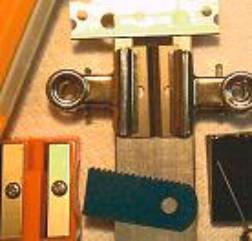
Some ideas
TOP - blade from a throwaway shaver. It can be popped out easily and has mounting
holes.
UNDER - Pencil sharpener blades (sharpener at
left) held in front of a 10 mm hole in Aluminium bar with small clips. These are easy to set. Simply place so the edges are in contact
with slit width of zero, then, using inertia, tap the side of the Aluminium
strip with a metal object such as a screwdriver blade. One blade will jar out of place leaving a very
even, thin, slit.
BOTTOM - a piece of high speed hacksaw
blade. The edge must be ground but it
is rust resistant.
After
adjustment, some dabs of glue will hold the blades in place if you want.
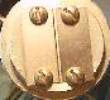
Spectrometer Slit from disposable Shavers
The result
is excellent, but the pencil sharpener blades make as good a slit on a short
term basis.
Shaver
blades are thinner and can buckle - pencil sharpener blades, when clamped to a
flat bar, are rigid and at exactly at the same level.
GOTO RONCHI INDEX