RONCHI
History
1929 - 1938
GOTO RONCHI INDEX
Copyright – P. J.
Smith
But
permission is given to distribute this material in unaltered form as long as it
is not sold for profit.
The Test Escapes
The years from 1929 to 1938 represent a period of
vigorous development for the Ronchi test.
This development, for the first time, was far removed from Europe. It
was also far removed from typical research establishments.
The USA in 1930 was in an ambivalent position. Despite its very young optics industry
developed under the pressures of WW1 it was very small on the world scale. Yet, in the field of large astronomical
telescopes the USA was at the cutting edge and ahead of most. Planning was near for the great 200 inch
Telescope.
Couple this with a vigorous and unique Amateur science
and Telescope making movement [1]
and the USA was fertile ground for development of uses for the Ronchi test.
First, however,
lets look at the 1929 article by Anderson and Porter.
In 1929 Anderson and Porter [2]
wrote an article in the Astrophysical Journal on the topic called
"Ronchi's Method of Optical Testing". John Anderson (of Wilson Observatory) and Russel Porter (a father
figure of ATM in the USA) are often credited (especially in the USA) with the
Grating/Grating implementation of the test for concave mirrors which was
referred to in this 1929 article.
The article is less about theoretical aspects of the
test and more about the practical application to optical testing. In reality the article was in essence simply
a report of the Ronchi test but it contained one new element which was later to
characterize an American variation of the test. Both of these persons’ prime interest was in large Astronomical
instruments. And since both were in
regular contact with the Scientific American editor of the ATM columns, an
absolutely unique situation existed that was to propel the Ronchi test forward
as the darling of an ATM movement that thrived on simple and cheap solutions. The Ronchi test was about to take on new
directions.
The following
small extract from the Anderson and Porter paper indicates the test that
Anderson and Porter inherited from Ronchi’s publications. It clearly shows that a slit source as well
as Ronchi’s early pinhole source was in use.
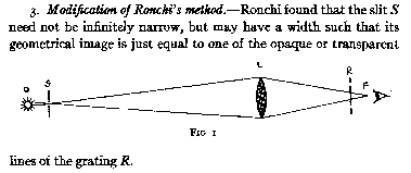
The one new
element that Anderson and Porter introduced was the possibility of using
different portions of the same grating as a combined source and occulter. Although obviously impossible in the lens
test set-up above, the arrangements below are suggested in the paper
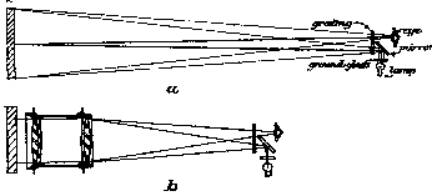
and the
arrangement is described by them below.
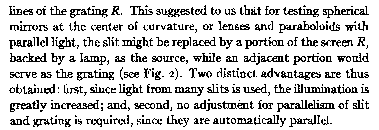
The Anderson and
Porter paper continued :- “We wish to call attention to a minor modification
of his first published method and to some results which we have obtained in
applying it to a few pieces of optical apparatus.”
“Instead of a
single slit, a line-screen illuminated by a frosted lamp or even by sky light
may be used as the source, with the advantage that the illumination is so
greatly increased that all the observations can be made in a fully illuminated
room. Also, for testing concave
spherical mirrors, or lenses and paraboloids with parallel light, only one
screen is required, one half of which serves as the source, the other half as
the observing screen. In this case the
lines of the image are automatically parallel to those of the observing
screen…………..the method is fully as sensitive as the Foucault knife-edge test.”
“Two distinct advantages
are thus obtained: first, since light from many slits is used, the illumination
is greatly increased: and second, no adjustment for parallelism of slit and
grating is required, since they are automatically parallel.”
Although they
considered this to be a new development, it is very similar to what was
described by Ronchi when he did the first experiments leading to the test. He states [3]
“We decided to
place a material grating at the same plane of the real image given by the
spherical mirror; the combination fringes were expected to disappear entirely
when the plane of the grating had passed the centre of curvature, because the
grating image should have coincided exactly with that object.”
He had subsequently moved towards a pinhole source as
more versatile and never pushed the grating/grating mode.
While Anderson and Porter’s claims about discovering a
significant improvement may be a little exaggerated, or even suspect, there is
absolutely no doubt the availability of the paper in English and the exposure
it was to receive in Scientific American and the ATM publications in the USA
was to have a huge impact on the adoption and development of Ronchi
testing. It also started a variant
using the grating/grating mode that was particularly favoured in the USA. The main advantage is more light throughput
and in some situations a simpler set-up, but whether it is superior is open to
question. Certainly it is a useful technique. For more information on this see slit/grating and grating/grating
comparison.
Most ATM’s will be familiar with a little of this
early material because some extracts are reprinted in ATM1 on p 269.
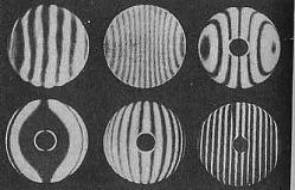
The illustrations accompanying this article were drawn
by Russel Porter to depict views obtained by using a 175 line/inch engravers
screen as a grating. He used the
Grating/Grating method which he seems to consider an improvement on the
original Ronchi Test. He says, “The Ronchi Bands seen through an engravers
screen are not perfectly sharp around the circumference. Various diffraction orders tend too blur the
right and left hand edges of the disk.
In drawing the patterns reproduced here I intentionally omitted the
blurred areas, in order to show more clearly the character of the patterns
produced by the grating when placed at stated distances from the focal plane of
the mirror (near its centre of curvature, not at the focus)”
The notes are specifically about concave mirror
testing although the 1929 article covers a refractor objective and photographic
lens as well.
The illustrations in ATM1 are taken from the original
article in the Astrophysical Journal.
See below.
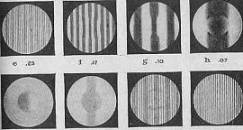
Russel Porter also makes a comment in the same ATM1
note that :-
“It was not anticipated, when developing this
modification of the Ronchi test, that its application to mirror inspection
would be found as useful as that for lenses.
But amateurs seem to be adopting it as a supplement to the knife edge,
and with the improvement of Kirkham in the use of woven mesh screens or wire
gratings, the method may come into quite general use.”
ATM1, containing this statement was first published in
1935. It is a good indication of the
spread of the test in a few years.
Porter mentions that the view around the periphery may
be unclear. He was using the
Grating/Grating arrangement. Other
workers noticed that the Grating/Grating method often produced less contrasty
results so used a slit with gratings made of threads instead. Some workers seem to consider diffraction
worse with certain types of gratings and set-up, also many thought one set-up
seemed to favour clearer images. I am
convinced much of this apparent confusion is simply due to the fact that,
unless gratings are of excellent quality, their performance in the
Grating/Grating mode gives different – often inferior – results. Both methods if used properly show
diffraction and both may produce excellent results.
The following are
mainly from the Scientific American columns edited by Albert Ingalls.
Since the Scientific American magazine was the agent
for the dissemination for much of this information, it is a fruitful source of
research material.
We should never forget that, while the Scientific
American ATM material edited by Ingalls was remarkable and included a higher
level of information on scientific matters than most other publications, it was
primarily a commercial concern and no substitute for a rigorous scientific
publication. Many times, sloppy
handling of material by Ingalls resulted in material going unpublished and
others being wrongly credited for developments.
In some ways, I am left with the impression that
Ingalls and a select group of close friends considered that they ‘owned’ the
ATM movement. Yet their contribution to
ATMing was immeasurable.
In the 10 or 15 years following Anderson and Porter’s
seminal publication, the Ronchi Test escaped and was eventually owned by
everyone.
1931 Ingalls, Scientific American, but only reported
Jan 1945. In
1931, Daniel E. McGuire, hit on the use of a slit in place of a pinhole in the
telescope mirror maker's Foucault knife-edge test. Ingalls regards this as
something new. Since the use of a slit
had previously been reported at least as early as 1929 by Anderson and Porter
with respect to Ronchi Testing so I find Ingall’s statement hard to accept.
1932 Ingalls. Albert. Scientific American, July
1932. Ingall’s reports
that Russel Porter & others have been experimenting with a slit instead of
a pinhole giving gains in light throughput and delicacy for the Foucault test.
Ingalls regards this as something new.
This is 3 years later than the appearance of Porter and Andersons’ paper
in the Astrophysical Journal about the use of a multi-slit source for Ronchi
Testing, also reporting Ronchi using a slit.
It also regards the use of an acetylene flame source as being normal at
Cal Tec. Again I wonder about the
accuracy of Ingall’s statements.
1932 Ingalls, Scientific American, Jun, 1932. Ingalls states
that workers cannot rely on visual estimates of shadows in Foucault testing but
must measure zones. Failure to do this has apparently resulted
in a large crop of badly overcorrected mirrors. So reports Everest.
Later in June 1939, Lower has a parallel lament
about people using the Ronchi test who think any set of curved lines is good
enough. He rants that “there would be
more good mirrors if the Ronchi test had never been heard of ”.
This sentiment was recently reechoed by Dick
Suiter in “Star Testing” despite the current availability of computer generated
simulations of Ronchi images for any mirror.
My experience is that
·
For spheres, the Ronchi test is excellent.
·
For very shallow parabolas, it is possible to
closely approach the required shape with care.
·
With deep aspherics, the Ronchi test MUST be
verified by other methods.
It is worth noting that the typical ATM mirror
is becoming very much deeper then what was made in the 1930’s.
1933? Alan R Kirkham (Amateur Telescope
Makers and Astronomers of Tacoma) had an article accepted for publication in
Scientific American (which is reprinted in ATM1, p264)
In this article he describes the original Ronchi test
as a slit/grating test and mentions the Anderson Porter grating/grating
modification. The difference is shown
in accompanying diagrams.
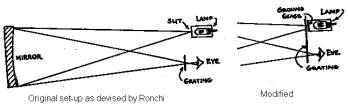
While Kirkham mentions using half tone engraver’s
gratings, the accompanying photographs he presents are taken with a grating
made of Silk Bolting cloth of 135 lines per inch in conjunction with a narrow
slit source. He suggests a slit be
made by drawing a razor blade across lead or copper foil.
Examples of
Kirkham’s Ronchigrams made
using woven Silk Bolting cloth and a slit
source.
The first one
shows air currents.
He also specifically comments on photographically made
gratings saying :-
·
“Most reproductions of engraver’s gratings with which
I have had experience have been objectionable for another reason :
they have a strong diffraction effect which may cause prismatic colours
and nearly always results in
showing two or three mirrors instead of one”
·
“The emulsion between the lines is never perfectly
transparent and thus the mirror is always seen as if surrounded by a heavy
fog.”
Quite a few comments may be derived from all of this.
1.
The photographs he used as illustrations are quite
good. Despite what some think, woven
gratings can produce excellent results.
For more information, see woven
gratings.
2.
He did not fully understand that any good grating
produces multiple images at the left and right edges and sometimes between the
bands at certain grating positions. For more information see diffraction effects. These multiple images are often less
obtrusive with woven gratings because the thread spacing varies slightly which
could explain what he saw.
3.
Any substrate, apart from optical glas,s does
introduce some scattering which results in the Ronchigram looking somewhat foggy. For more details see printer and copier made gratings.
Although he did not specifically mention it, nor identify the mechanism, a
‘foggy’ image also results if anything but a perfectly spaced grating is used
in the grating/grating mode. He may
have been thinking of some set-ups he had seen using this mode with
photographic gratings. It is possible
some distortion may have varied the spacing slightly. See slit source v
grating source comparison.
It is interesting that the combination of a slit with
woven cloth works well but other combinations using this do not. He obviously experimented to find the best
combination with the materials on hand. Unless
unimpeachable gratings
are used in the
grating/grating mode, it is a retrograde step. Anderson and Porter probably
only had the very best so never really experienced this problem.
1934 J. H. King, JOSA, 24, 250, (1934) "A Quantitative Optical Test for
Telescope Mirrors and Lenses".
King developed a quantitative variation of the Ronchi
test to quantitatively measure the Asphericity of concave surfaces. He used a slit (one to two thicknesses of paper) and a "Grating reduced to
a single wire".
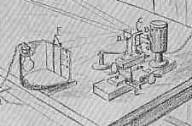
Above is
King’s set-up. The arrangement on the
left projected two bright vertical lines which are superimposed over the Ronchi
image via a semi-reflecting glass plate.
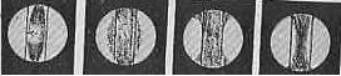
The view was
arranges so the superimposed reference lines spanned the centre,
then the
extremity, of a Ronchi band as shown by moving the rig longitudinally with a
screw
much as zonal
Foucault readings are made.
1934 Ingalls. Albert. Scientific American, Apr 1934. Ingalls reports Mr Shumaker worked out a method of making the Ronchi test quantitative and comments further that Dr. J. A. Anderson of the Mount Wilson Observatory has independently worked out a similar method, and Mr. Franklin B. Wright, 155 Bret Harte Road, Berkeley, California, Chairman of the Eastbay Astronomical Association and co-author of "A.T.M." (pages 257~261), is also said to have worked out something similar.
1934 Ingalls, Scientific American Dec 1934. Ingalls reports that Alan Kirkham recommends
Ronchi testing of rifle telescopic
sights objectives and erecting lenses. He specifies that the bands curve the
opposite way from mirror testing.
1935. Ingalls, Scientific American, Mar 1935. Reports a Lincoln Davis performed variations of the Ronchi test in broad daylight, or with any ordinary unshielded lamp by placing a piece of ruled celluloid over a white card having a hole in it, to look through. Alternatively, a grating was made by winding some fine wire. The wires facing the mirror were polished, with the side to face the eye blackened. In this case the polished wires act as very bright sources, with the added advantage that these sources and the point of observation are practically coincident, eliminating parallax effects.
1935. Ingalls, Scientific
American, May 35.
Reports that the first published account of making the Ronchi test
quantitative was that of J. H. King in JOSA, Sep, 1934 but that Loren L. Shumaker and Alan R.
Kirkham also worked out methods.
Kirkham’s method was sent to Ingalls a year earlier but was mislaid and
not published in Scientific American.
In essence his method was to adjust the grating so that two bands at the
center of the disk are 1 inch apart (say) and mark the position. Then move the
grating back so that the bands are 1 inch apart at the rim. The movement should
match the calculated value. This is in essence similar to the method used by
some advocates of the ‘Matching Ronchi Test’ today. Note that King’s method was
first reported in JOSA in 1934 – see above.
1935. Ingalls, Scientific American, Nov 1935. Describes how a
Benjamin J Phillips was using a single hair in place of the Ronchi grating in
conjunction with a pinhole. He also
mentions that a comb may be used as a Ronchi grating – also that the Ronchi
test was particularly valuable for deeper mirrors. Some combs available once
had finer and more regular teeth than what we find today but one suspects this
technique may have been a little substandard.
1936. Ingalls, Scientific American, Apr, 1936. Ingalls lists comprehensive results of
experiments by Horace Selby where he compares the sensitivity and usefulness of
Ronchi and Foucault on surfaces ranging from F:1 to F:12 in direct and null
tests. He deliberately polished grooves
with a very small lap in the surfaces and used a 120 wire grating. His conclusions indicated superiority in
some cases. Everest seems to favour the
Foucault test in all cases.
Apr 36 HERE are some solid data from Horace n H. Selby, a chemist, of San
Diego. "Since last you wrote," he says, "I've attempted to
compare the Foucault test with the Ronchi, on several surfaces, both directly
and with a flat. Briefly, my conclusions are:
"1: The two methods are equa1 in sensitivity at f/6 direct, and
at f/12 with a flat.
"2: Ronchi is better at large aperture ratios: f/l, f/2.3,
f/4.5.
"3: Foucault is better at small ratios: f/6.8, f/8, f/10.
"4: Neither is sensitive enough ( 0.1 wave)
below f/4.5.
0.1 wave)
below f/4.5.
"5: Straight-edge, diffraction (Everest test) and Ronchi are equal for
edge.
"6: When using a flat or a Hindle sphere, these surfaces must be pretty
near to fairly good: 0.1 wave is
none too close.
"All of the above was done with 120-line- per-inch Lower wire grating
and smoked razor blade. In all comparisons, source (pinhole) and eye were
precisely together on the axis. Surfaces used had apertures of 1.09, 1.4, 2.3,
3.5, 4.5, 6, 8, 10 and 11.3. Sensitivity was judged by polishing grooves in
surfaces with pitch laps l/8" diameter, loaded 50 grams per square
centimeter, and using black rouge washed from worn-down stock.
"Don't forget," Selby adds, "that other may not get the same
results."
Everest commented - "I choose the old tin can and razor blade."
Sheib- "Interesting. I agree with Selby on No. 3, also No. 4 and No. 5. I
am not sure I agree with him on No. 1 or No. 2."
Ingalls here is admitting that a ‘wire mesh grating’
may be better. Very strange. One suspects that Ingalls is mainly reporting hearsay. Whatever Ingalls says, the tests made by Selby seem an admirable attempt
to obtain good experimental data. They
are probably quite reliable. Everest
was probably a little prejudiced against the Ronchi test but he was most
certainly a very experienced and capable mirror worker.
July 36 Ingalls, Scientific American. Ingalls indicates that Ronchi
himself may have been the first to make the Ronchi test quantitative. He makes no attempt to research original
publications to substantiate this, however.
July 36 Ingalls, Scientific American. Ingalls describes how in about 1933, Alan R. Kirkham suggested a test in which a pinhole is placed at the focus of a paraboloid, the rays being reflected as parallel rays and received by another paraboloid, then brought to focus and cut by the knife-edge. This was published only as a multigraphed sheet which not everyone saw. Subsequently, three others conceived the same idea and one of them eventually received the credit.
1936 Ingalls, Scientific American, May 1936. Ingalls passes on comments about the first photographs taken with Harold Lower's (and his father, Charles Lower) Schmidt. This is an historic telescope which was tested using a variation of the Ronchi test.
193?
Searchlight mirrors are tested by a grid at the focus before acceptance
by the French Navy. Probably from
Charles Deve in Optical Workshop Principles – a translation of his original
French book published in 1949.
1936. Ingalls, Scientific American, Nov 1936. Ingalls describes comments from Hari Charan, Calcutta about a mirror figured using tests including a test with a Ronchi grating of 10 hairs per 1/10 inch.
1937. Ingalls, Scientific American, Aug 1937. Ingalls describes Professor Yeagley’s tester
from correspondence about a year ago.
It includes a slit for use with the Foucault and Ronchi test. The Ronchi grating is 175 wires per inch and
may be mounted in an eyepiece. The slit
is made by making a scratch across a piece of aluminised glass. This is an excellent method. Aluminising over a fine fibre has also been
used to make excellent slits.
1938 R. L. Wallard. J. Sci. Instr. 15, 339, (1938) Wallard made a
Schmidt using a Slit at the focus as a source which was re-imaged via a
refractor through a Ronchi Grid made of 120 wires per inch. This is especially about examining an
unpolished surface smeared with oil. He
went on to make a 30/36 inch Schmidt for St. Andrews University, Scotland. Some
testing was via an oil flat in autocollimation when he used the Grating/Grating
mode.
1938 John Strong.
"Proceedings in Experimental Physics", p 77 - 78 Uses both Grating/Grating and Slit/Grating
variations depending on the optics under test.
This excellent publication, a Laboratory Manual, helped to spread
knowledge about Ronchi Testing. Unfortunately, some of the Ronchigrams in
this book have been transposed and are incorrect.
1938 Ingalls, Scientific American, Jun
1938. Ingalls
reports on Kirkham’s use of a Ronchi grating when testing eyepieces. This is
extended to quantitative measurements of Spherical aberration.
1938 HW and LA Cox.
Journal of the British Astronomicaql Society. 48, 308-313, (1938) "The Construction of a Schmidt
Camera". This describes construction of a Schmidt camera. Used a Slit and a Grating.
1939 Ingalls, Scientific American, June 1939. Lower laments that many people using the
Ronchi think any set of curved lines is good enough. He rants that “there would be more good mirrors if the Ronchi
test had never been heard of ”.
Predates a similar call by Suiter in ‘Star Testing’
Other Developments
At the same time that a range of practical uses was being investigated, predominantly by Amateurs in the US, studies were being done elsewhere, mainly in Italy.
I have no access to these sources. Some, however, are mentioned in Malacara.
1928. J. Jentzsch, Phys. Z. 24, 66, (1928) "Die Rastermethode, ein Verfahren zur
Demonstration und Messubg der Spharischen Aberration". Develops a good
geometric treatment.
1929. V. Ronchi. Z. Physik. 55, 717, (1929)
1930. V. Ronchi. Rend. Accad. Naz. Lincei. 11, 998,
(1930). Studied the
sensitivity of the Ronchi test.
1930. V. Ronchi. Nuovo Cimento. 7, 248, (1930). Studied the
sensitivity of the Ronchi test.
1930. F. Scandone. Nuovo Cimento. 7, 289, (1930). Studied patterns
for 5th order spherical aberration.
1931. V. Ronchi. Nuovo Cimento. 8, 265, (1931)
1931. F. Scandone. Nuovo Cimento. 8, 157, (1931). Extensively studied Astigmatism effects on
Ronchigrams. Also studied combined
Astigmatism and Spherical aberration.
1931. F. Scandone. Nuovo Cimento. 8, 310, (1931). Also studied combined Astigmatism and
Spherical aberration.
1931. F. Scandone. Nuovo Cimento. 8, 378, (1931). Extensively studied Astigmatism effects on
Ronchigrams. ) Also described usefulness of a circular
grating. This was later revisited by
Murty and Shoemaker in 1966. See non-linear gratings for more details.
1932. F. Scandone. Boll. Assoc. Ottica. Ital. 6, 35,
(1932) Described usefulness of a circular
grating. This was later revisited by
Murty and Shoemaker in 1966. See non-linear gratings for more details.
1932. R. Bruscaglioni. Rend. Accad. Naz. Lincei. 15,
70, (1932)
1932. F. Villani ans R. Bruscaglioni. Nuovo Cimento.
9, 1, (1932). Extensively
studied Astigmatism effects on Ronchigrams.
1932. R. Bruscaglioni. Boll. Assoc. Ottica. Ital. 6,
46, (1932). Extensively studied Astigmatism effects on
Ronchigrams.
1933. R. Bruscaglioni. Boll. Assoc. Ottica. Ital. 7,
78, (1933). Extensively studied Astigmatism effects on
Ronchigrams.
1933. R. Bruscaglioni. Boll. Assoc. Ottica. Ital. 7,
100, (1933). Studied the
sensitivity of the Ronchi test.
1933. R. Crino. Boll. Assoc. Ottica. Ital. 7, 113,
(1933). Studied the
patterns for the primary aberrations.
193?
Searchlight mirrors tested by a grid at the focus before acceptance by
the French Navy. Probably
from Charles Deve in Optical Workshop Principles – a translation of his
original French book published in 1949.
1938. R. Crino. Ottica. 3, 304, (1938)
1938. R. Calamai. Ottica. 3, 41, (1938). Extensively studied Astigmatism effects on
Ronchigrams.
1939. R. Platzeck and E. Gaviola. JOSA. 29, 484,
(1939) "On the
Errors of Testing and a New Method of Surveying optical Surface and
Systems"
1939. Di. Jorio. Ottica. 4, 31, (1939)
1939. Di. Jorio. Ottica. 4, 83, (1939)
1939. E. Ricci. Ottica. 4, 104, (1939)
1939. B. Crino. Ottica. 4, 114, (1939)
1939. Di. Jorio. Ottica. 4, 184, (1939). Studied wave
theory as applied to the Ronchi test.
1939. R. Bruscaglioni. Ottica. 4, 204, (1939). Studied the sensitivity of the Ronchi test.
1939. Di. Jorio. Ottica. 4, 254, (1939). Studied wave
theory as applied to the Ronchi test.
1940. G. Bocchino. Ottica. 5, 219, (1940)
1940. V. Ronchi. Ottica. 5, 275, (1940)
1940. G. Bocchino. Ottica. 5, 286, (1940)
GOTO RONCHI INDEX