Wire and Solid Gratings
GOTO RONCHI INDEX
Copyright – P. J.
Smith
But permission is given
to distribute this material in unaltered form as long as it is not sold for
profit.
Comb
Grating
Others have
used a very fine comb. The type once
sold as flea combs for pets used to be very fine and regular. Modern ones seem poorly made by comparison.
I have not
tried the comb idea but expect it to work reasonably well if a little course
for good Ronchi testing. A coarse grating – as long as the edges are clean and
the spacing regular – will still work very well but sensitivity will be low with
many bands across the Ronchigram.
Wire Wound and Fibre
Gratings
A very old idea is to make a grating by positioning wire, hair or other
fibres across some frame.
Some see it only as a temporary makeshift method but others consider a
carefully made wound wire grating superior to many other types of gratings.
Consider the diagram illustrating how a wire wound grating may be
produced.
The steps are :-
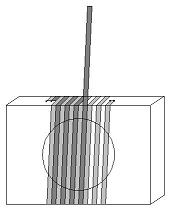
(a) Prepare a rectangular substrate such
as Aluminium or Plastic. Drill a hole
through it. Alternatively use a plastic
35 mm film transparency holder.
(b) Attach a pair of thin copper wires
on one edge of the substrate. In the
diagram, this is shown at the top left edge.
Glue may be used.
(c) Wind both together as closely spaced
as possible.
(d) Fix one of the strands on the top
right edge.
(e) Carefully unwind one strand.
(f) Glue the remaining strand along the
edge and one face.
(g) Cut away the strands on one side of
the substrate.
There are some possible variations such as simultaneously making two of these
gratings back to back. In this case
they are simply separated by cutting along the edges.
Some pertinent facts are :-
·
It is
harder than you might think to maintain a constant spacing. On the other hand, a grating of only two
wires can never be wrong and it is very useful.
·
A
single wire, although hardly a Ronchi grating, is very useful and its action
may also be simulated by using the accompanying program “RonchiNu”. Note that the so called “wire” test uses a
pinhole.
·
A very
useful “Grating” consists of three sections.
One part consists of an isolated single wire. Another isolated portion contains a twin wire set. The third part consists of maybe 6 wires.
·
Maintaining
even tension when winding is difficult, especially around a rectangular frame. This is greatly facilitated by using a
somewhat elastic material such as nylon monofilament fishing line.
·
Fine
copper wire, while readily available, is one of the worst choices for winding
because it has low tensile strength accompanied by ductility. This often results in a loss of tension,
which allows the wires to buckle slightly.
·
While
opaque materials are best, translucent materials perform well as long as the
test area is dimly illuminated.
A crafted wound grating is as good as any and better than most, but
there is no compelling reason to make one. A woven Grating is recommended as
quicker, easier, and quite satisfactory.
A very useful practical compromise is to mount in a plastic 35 mm transparency
frame a combination of single wire, double wire and woven material alongside
each other.
If you have not already done so, read up on Woven Gratings.
An On Axis Rig using a Wire Grating
A rather unusual application of a wire wound grating which ensures exact
on axis performance is documented in an early Scientific American article. I have never tried the idea but it sounds
perfectly feasible to arrange a wire wound grating using this on axis system.
GOTO RONCHI INDEX