Professional and
Photographically made Gratings
GOTO RONCHI INDEX
Copyright – P. J.
Smith
But permission is
given to distribute this material in unaltered form as long as it is not sold
for profit.
While this is a fascinating topic it is easy to forget that excellent Ronchigrams may be obtained using other grating materials which are detailed elsewhere.
Unless gratings like these are readily available at low cost and with no effort, do not bother with them.
Vasco Ronchi initially used
gratings derived from the printing industry where the lithographic process of
printing required half tone images to be broken into a two dimensional pattern
of dots. Although the printing industry
did use physically woven screens, the photographic process was the most
versatile method of producing a large range of quality gratings available.
Images could be left on
photographic emulsions or used to produce a pattern of resist on a substrate,
which could then be etched and filled with a highly opaque material.
Quality Graticules and
circuit patterns on microchips are produced today by related processes.
High quality Gratings
available today fall into the following categories
1.
Grooves
are diamond ruled directly on glass.
The grooves are subsequently filled by an opaque material such as
pigmented epoxy.
2.
Rulings
are made directly on an opaque coating on glass removing some in a pattern of
lines. This is usually done on a thin
metal coating on glass.
3.
A
material such as a metal is coated on glass through a precision mask. The mask is subsequently removed leaving a
fine pattern of opaque metallised lines.
This is especially used when extremely fine and precise gratings are
needed. These are quite unnecessary for
Ronchi testing.
4.
An
etchant is applied to glass through a precision mask. The mask material is subsequently removed and the etched grooves
are filled with an opaque material such as pigmented epoxy. This process is used to make the economical
range of good gratings available from, for example, Edmonds.
5.
A
photographic image is formed within a gelatine coating on the surface of
glass. Special photographic plates are
made which produce extremely precise, fine-grained and dense images such as for
complex graticules. Use of films and
plates intended for other purposes such as Lithographic film can produce very
good results. Even normal fine grain
film processed for high contrast will suffice but it cannot match the special
purpose materials for extreme quality.
Patterns on the mask
material used in methods 2 and 3 may be produced either by a direct ruling or a
photographic process. The old light
activated Bichromated glue process derived from the printing industry or modern
variants used in the microchip industry may be used.
No doubt other methods will
become available as technology marches forward but beware that the results
available from commonly available printers and laser copiers are quite inferior
and much better grating materials are readily available. More details are available under printer and copier made gratings
and woven gratings.
Grating Examples
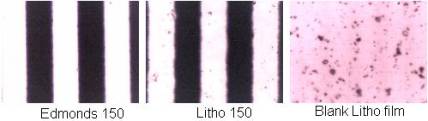
These photographs compare
some typical gratings. The first is an
Edmonds etched and filled grating made on a polished glass substrate. The next two photographs show what can be
expected of a photographically made grating using Litho film. The equipment used was a good quality but
typical 35 mm camera. No special Litho
developer was used.
The Edmonds grating, which
uses a glass substrate, has cleaner opaque areas and slightly sharper line
edges.
A better lens may have
improved the edges of the Litho grating but nothing can remove the slight
surface roughness of the gelatine emulsion on the film.
This surface roughness is
very obvious on the photograph of the blank film although the illumination used
to take the photograph makes it look worse than it really is.
In practice this surface
roughness introduces slight scattering and diffusion of the bands in the Ronchi
image but usually the result is very acceptable when used with a slit. If the light passes the grating twice when
Ronchigrams are produced by the Grating/Grating mode, film gratings often give
a noticeably more diffuse image.
With time the difference
between the performance of an etched glass and a film grating becomes more
obvious. The glass can be cleaned while
the film deteriorates.
It is worth pointing out
that wire wound or woven gratings never suffer from this defect. They may have other problems, but the amount
of scattered light is a minimum.
Unequal Gratings
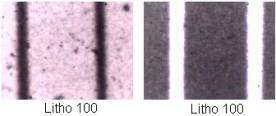
It is easy to produce
different ratios of light and dark using the photographic process.
This has been used to
produce narrower and more contrasty bands in Ronchigrams and was described by
DeVany in “Applied Optics” mmmmmm. He
shows results of different combinations used in the Grating/Grating mode.
He seems to have missed the
fact that by varying the width of a slit in conjunction with a grating a large
measure of control is already available.
More variation is available by simply dissolving away some of the
metal in a woven bronze grating in
Nitric acid.
My preference is for a
grating with dark spaces somewhat narrower than the light areas but do not
consider results from these extreme gratings above as especially worthwhile. See Non-linear
and unequal Gratings.
Non-Linear Gratings
Certain special types of
gratings are difficult to make by any method other than the photographic
process. Examples are the so called Mobsby, Popov and Circular Gratings.
GOTO RONCHI INDEX