RONCHI
History
1946 – 1969
GOTO RONCHI INDEX
Copyright – P. J.
Smith
But
permission is given to distribute this material in unaltered form as long as it
is not sold for profit.
More Serious Uses in an era when interferometric tests were
becoming the norm. The developments of
Shearing Interferometers produced a new surge of interest in the Ronchi test.
Rational and more Rigorous Analysis becomes the
norm in an age of new tests. Wartime
skills were put to work and research performed during WW2 became accessible.
Opticians demanded to know exactly how much bend should be evident in aspheric
Ronchigrams. Ronchi’s team did answer some of these questions earlier but the
results were buried because of wartime conditions and communications. Money and a popular movement in the US
caused a lot of these factors to be researched and sometimes rediscovered.
New specialist publications catering to research
blossomed and became widely available both in research and production
environments. Significant expansion to,
or initiation of publications such as Applied Optics, JOSA, Journal of
Scientific Instruments and Sky and Telescope occurred. Scientific American eventually declined to
insignificance although their publications of collected materials in ATM1, 2
and 3 became the Bible for a generation of ATM’s. Some of this material, was,
however, quite dated.
The avionics industry expanded to include Space
based surveillance optics and University departments received funding to
investigate fundamental issues of imaging and optical production. Many large telescopes were either planned or
completed. These were produced to a new
order of precision.
Although it was not fully apparent at the time,
the normal Ronchi test was being displaced by new methods or Ronchi variants
but researchers investigated it hoping for major breakthroughs. The development of shearing interferometers gave
an impetus to research on Ronchi testing because of similarities. Lasers made
many research curiosities viable tests.
Newer computing methods were changing what was
possible with respect to test analysis but this facility remained unavailable
to private individual users.
Many of the developments are so specialized that
they have little relevance to ATM’s.
These are listed for completeness but few details are given except in
special cases of interest.
1946. Hamsher, D. H.
JOSA36, 291-295. Describes ‘Screen
Line Tests for Paraboloidal Mirrors”
Related to the
Lower variation.
1948. Ingalls, Scientific American, Nov 1948. Ingalls reports on arguments about the curvature seen on the Ronchi bands. This started George P. Arnold a graduate student in physics, on a hunt for a general formula by means of which the exact shape of the bands for a mirror of given specifications may be worked out in advance for the particular Ronchi grating used. He found one which he says will do the trick with fewer pains than may at first appear. The formula was developed independently of the method and related formula that are alluded to in Amateur Telescope Making-Advanced, page 108. That approach was developed in 1932 by Franklin B. Wright.
Arnold’s analysis concluded that :-
The correct appearance of the bands for any point inside or outside focus may be plotted. The lines are drawn in for the separations between the light and dark shadows thrown by each wire or edge of the grating, and the areas within these boundaries are blacked in solid. The formula is:
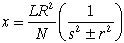
x is the distance of a point on a band from the vertical diameter of the mirror;
L is the distance of an edge of the actual grating wire measured horizontally from the optical axis;
R is the radius of curvature of the mirror;
N is the fractional correction (for a parabola, N = 1 );
r is the distance of a chosen point on a band from the optical axis;
s is the radius of the zone, at the focus of which the grating lies. (s is related to the distance of the grating from the center focus by d = Ns2/R.)
The plus sign is used in the denominator if the grating is outside the center focus, and the minus sign if it is inside.
The formula is easy to apply, using cross-section paper and a compass. Take, for example, a six-inch f8 mirror and a grating having 200 lines per inch. Suppose we want the correct appearance of the bands when the grating is 0.15 inch inside center focus. In this case L1 is 0.00125 - inch; L2 is three times that amount or 0.00375 inch; L3 is 0.00625 inch; R is 96 inches, N is 1; and, since s2/R is to be 0.15 inch, s2 is 14.4.
Confining our attention to one side of the first band we have
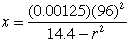
The compass is set at values of r and swung to the corresponding x's calculated from this equation, where points are marked. Enough points are plotted to enable a smooth curve to be drawn joining them. This is done for the L's on both sides of the center until the bands no longer fall within the circle which represents the mirror. Any values of x that turn out larger than the corresponding r are discarded. Typical results are given
.
I suspect that this is actually an approximation (but quite useful) and that the rigorous analysis had to wait until Sherwood and Malacara attacked the problem.
1948. Lau, E. Ann. Phys. 6, 417. “Bengungserscheinungen an Deppeltrastern” Showed that the Autoimaging of gratings – the Talbot effect, also occurs with the grating/grating mode as well as the slit/grating mode. A photograph showing the Talbot effect producing multiple imaging can be seen under diffraction.
1949. D. H. Rank, P. R. Yoder, Jr., and J. Vrabel,
JOSA. 39, 36, (1949)
"Sensitivity of a Rapid Test for High Speed Parabolic Mirrors"
This mainly looks at the capability of the Lower variation.
1949. Ingalls, Scientific American, Jun 1949. Ingalls reports on Waland’s use of an oil flat
combined with a Ronchi test. Note that
this is 10 years out of date although obviously of interest to many.
1949. Ingalls, Scientific American, Oct 1949. Ingalls describes many very early testing
techniques predating the Foucault test.
Very informative article on early testing has nothing on Ronchi testing.
1953. H. S. Coleman and H. E. Rosenberg. JOSA.
43, 813 (1953). "The Grating
Interferometer"
1954. H. A. Lower. ATM 2. Albert G. Ingalls - Ed. p 410. "Notes on the Construction of an F/1
Schmidt Camera"
1954. J. B. Saunders.
JOSA. 44, 664, (1954).
"An Improved Optical test for Spherical Aberration"
1958. C. Morais.
Atti. Fond. Giorgio Ronchi Contrib. 1st Naz. Ottica, 13, 546, (1958) "Riassunto del Applicazioni dei
Reticoliallo Studio delle Aberrazoni dei Sistemi Ottica" (About the Applications of Gratings to the
study of the Aberrations of Optical Systems)
1958. V. Ronchi. Atti. Fond. Giorgio Ronchi Contrib.
1st Naz. Ottica 13, 368, (1958).
"An Elementary Introduction to the Use of the Grating
Interferometer".
1958. A. A. Sherwood. J. Br. Astron. Assoc. 68, 180,
(1958). "A
Quantitative Analysis of the Ronchi Test in Terms of Ray Optics". He developed rigorous expression for
transverse aberration so predicting Ronchi Patterns. This was the same as developed by Malacara in 1965 by a different
method.
1959. P. Erdos. JOSA, 49, 865, 1959. "Ronchi Test of Fifth Order
Aberrations" were studied and their effect on thr Ronchi Pattern.
1959. A. A. Sherwood. J. Proc. R. Soc. NSW. Aust.
93(43?), 19, (1959).
"Ronchi Test Charts for Parabolic Mirrors". Using the theory
he developed in 1958, Sherwood prepared a series of charts to show the curves
for different parabolas. Some of these were published in Sky and
Telescope. See aspherizing for an example.
1958. P. R. Yoder, Jr., JOSA. 49, 439, (1959). Further Analysis of the 'Lower' Test for
High Speed Parabolic Mirrors"
(The "Lower" test is another name for placing a slit or
grating at F and viewing through the front of the telescope). This looks at the
sensitivity of the Lower variation.
1959. E. Lumley. Amateur Astronomers. (Sydney),
(1959). He prepared ideal Ronchigrams to guide mirror makers to
produce parabolas.
1960. I. Acachi, Atti Fond. Giorgio Ronchi Contrib.
1st. Naz Ottica 15, 461 (1960).
"Quantitative Measurement of Aberration by Ronchi Test". Discusses measurement of the primary
aberrations.
1960. I. Acachi, Atti Fond. Giorgio Ronchi, Contrib.
1st. Naz Ottica 15, 550 (1960),
"Quantitative Measurement of Aberration by Ronchi Test" (cont.) "Quantitative Measurement of
Aberration by Ronchi Test".
Discusses measurement of the primary aberrations.
1960. E. Lumley.
Atto Fond, Giorgio Ronchi Contrib. 1st Naz. Ottica, 15, 457, (1960). "A Method of Making a Ronchi Test on
an Aspheric Mirror"
1960. A. A. Sherwood. Atti. Fond. Giorgio Ronchi
Contrib. 1st Naz. Ottica. 15, 340, (1960). "Ronchi Test Charts for Parabolic
Mirrors". Using the theory he
developed in 1958, Sherwood prepared a series of charts to show the curves for
different parabolas. Apparently, these
are still known as ‘Sherwood’s tables’ in Italy.
1960. E. Lumley. Sky & Telesc. 22, 298, (1961). "Figuring a Paraboloid with the
Ronchi Test"
1961. D. Malacara.
Appl. Opt. 4, 1371, (1965).
"Geometrical Ronchi Test of Aspherical Mirrors"
1962. I. Acdchi, Atti Fond. Giorgio Ronchi,
Contrib, 1st. Naz Ottica 17, 252
(1962) "The Recent History of Grating Interferometer
and Its Appliocations"
1962. V. Ronchi. Atti. Fond. Giorgio Ronchi Contrib.
1st Naz. Ottica. 17, 93, (1962) and 17, 240, (1962)
"Forty
Years of Gratings".
1962. R. Wehn.
Atti. Fond. Giorgio Ronchi Contrib. 1st Naz. Ottica. 17, 39, (1962). "Die Methode der Ronchi-Gitter in der
Praxis" (The Method of the Ronchi
- Ruling in Practice). General Description of thr Ronchi test.
1963. I. Adachi, Atti Fond. Giorgio Ronchi. 1st. Naz Ottica 18, 344 (1963) "The
Diffraction Theory of the Ronchi Test" A mathematical treatment using
Fourier theory. Later extended by
Barakat.
1963. F. W. Phillips. Sky & Telescope. 25, 110,
(1963).
"Aspherizing and Other Problems in making Maksutov Telescopes"
1963. R. E. Cox. Sky & Telesc. 25, 114, (1963). "The Hot Wire Foucault Test"
1963. Jurgen R. Meyer. et al. Appl. Optic. 2, 1, 77,
(1963).
"Angular Measurements by Means of a Ronchi Grating"
1964. G. Vogl. Appl. Opt. 3, 1089, (1964). "A Phases Grating
Interferometer" Describes a
simple set-up to demonstrate use of a phase grating. It seems a curio but is not.
See phase gratings for more
details. Vogl was the first in print to
mention phase Ronchi gratings but it would seem that Ronchi experimented with
them much earlier. As far as first
publication, Ronchi concedes this to Vogl.
1964. V. Ronchi. Appl. Opt. 3, 437, (1964). "Forty Years
of History of a Grating Interferometer"
A ‘must read’ article spanning most of the history of Ronchi
Testing. Mentions early experiments
with making and using Phase gratings.
1965. A. S. DeVany, Appl. Opt. 4, 831 (1965). "Some Aspects of Interferometric
Testing and Optical Figuring"
Describes easy methods of qualitatively estimating surface profiles from
various Ronchigram patterns. Also discusses some methods of computing surface
shape and problems of interpolation.
1965. D. Malacara.
Bol. Obs. Tonantzintla Tacubaya, 27, 73, (1965). "Ronchi Test and Transversal
Aberrations". Discusses how Ronchi test really measures Transverse
Aberrations. He developed rigorous expression for transverse aberration so
predicting Ronchi Patterns. This was
the same expression as developed by Sherwood in 1958 by a different method.
1965. V. R. K Murty and A. H. Shoemaker. Appl. Opt. 5,
2, 323, (1965).
"Theory of Concentric Circular Grid"
1965. V. Ronchi. Appl. Opt. 4, 1041, (1965). "On the Phase Grating Interferometer"
1965. Daniel Malacara. Appl. Opt. 4, 11, 1371, (1965). "Geometrical Ronchi Test of
Aspherical Mirrors" He developed rigorous expression for transverse
aberration so predicting Ronchi Patterns.
This was the same as developed Sherwood in 1958. This was the same expression as developed by
Sherwood in 1958 by a different method.
He also discusses ‘projection error’ which may be applicable to
extremely deep mirrors. He also
suggests that for maximum information, if K > 0 the grating should be near
the paraxial focus but when K < 0 near the end of the caustic.
1965. Journal of Scientific Instruments. 4, 42, 825,
(1965). "The
Production of Uniform Slits by Electro-Erosion of Razor Blades.
1966. A. S. De Vany.
Appl. Opt. 5, 6, 867, (1966). "A Universal Tester"
1966. M. V. R. K. Murty and A. H. Showmaker. Appl. Opt. 5, 323 (1966). "Theory of Concentric Circular
Grid" Described usefulness of a circular grating. This had been investigated previously by
Scandone in 1931 and 1932. See non-linear gratings for more details.
1967. A. S. DeVany.
Appl. Opt. 6, 1073, (1967).
"Spherical Aberration Analysis by Double Wire Testing"
1968. G. L. Miles.
Appl. Opt. 7, 5, 976, (1968). "The Production of Fresnel and Sine
Wave Plates"
1969. Pastor.
J. Appl Opt. 8, 525-531. “Hologram
Interferometry and Optical Technology”
First to suggest that a special form of curved grating could compensate
for the asphericity ofthe surface to produce straight lines in the
Ronchigram. This was later taken up by
Mobsby and Malacara.
1970. A. Cornejo and D. Malacara, Appl. Opt. 9, 1897, (1970). "Ronchi Test of Aspherical Surfaces,
Analysis and Accuracy". Particularly
studies the sensitivity of the test.
1970. A. S. DeVany, Appl. Opt. 9, 1944 (1970). "Quasi-Ronchigrams as Mirror
Transitive Images of Interferograms" Describes easy methods of
qualitatively estimating surface profiles from various Ronchigram patterns. He
tries to present a systematic pattern to help opticians during figuring. Especially aimed at spherical optics.
1970. H. Salzmann. Appl. Opt. 9, 1943, (1970). "A Simple Interferometer Based on the
Ronchi Test" Used the test to evaluate the quality of laser rods.
1970. A. S. DeVany. Appl. Opt. 9, 1219, (1970). "Supplement to: Some Aspects of
Interferometric Testing and Optical Figuring" Describes easy methods of
qualitatively estimating surface profiles from various Ronchigram patterns. He
tries to present a systematic pattern to help opticians during figuring. Especially aimed at spherical optics.
1970. A. S. DeVany. Appl. Opt. 9, 1720, (1970). Supplement to: Aberration Analysis by
Double Wire Testing" This has
little to do with Ronchi Testing. It
uses two wires, each in a different plane.
The patterns are different from normal Ronchi patterns. They were closer to normal Interferograms
and De Vany seemed to think this made it easier to interpret. In my opinion, rather confusing.
GOTO RONCHI INDEX