RONCHI
Phase Gratings
Production
and use of Phase gratings for Ronchi Testing.
GOTO RONCHI INDEX
Copyright – P. J.
Smith
But permission is
given to distribute this material in unaltered form as long as it is not sold
for profit.
A phase grating
retards instead of blocks selected rays.
This has the following
potential advantages :-
·
Because
all of the light is transmitted, the image is usually brighter.
·
Many
of the phase related tests (e.g as developed by Zernike, Burch and others) are
more sensitive. It would seem this is also true of phase gratings used in
Ronchi testing.
Methods that have been used
to create selective path difference in phase tests are
1.
Selective
etching of a glass surface via a pattern of resist. Raleigh did something similar.
2.
Deposition
of thin layers in a selected pattern.
Zernike originally used thin squashed specs or whiskers of rosin. A more
modern technique is to deposit layers through a mask as is done in electronic
chip manufacture.
3.
Chemically
altering a portion of the gelatine layer in film. This is routinely done when
recording holograms on film. Special
films have been developed but any film works to some extent. In essence, the silver image is bleached
away leaving some gelatine transparent but slightly altered optically.
At face value these
techniques are outside an ATM’s reach but there are some ways around the problem.
Unfortunately, the
available phase gratings may have little advantage over other readily available
alternatives. The results are, however,
interesting, and in some cases actually superior.
The first phase grating I
ever used was a transparency printout by an inkjet printer. On detailed microscopic examination of the
inkjet image it was obvious it would never work very well in normal Ronchi
testing. But it does in fact work far
better than expected. The Ronchi image
also has an Ethereal quality peculiar to phase gratings. Ronchi himself produced some of the first
gratings of this type.
There is extra material
including microphotographs of inkjet gratings which you should examine under Inkjet and Laser produced gratings.
The next step in this
interesting saga occurred when I accidently turned an Inkjet grating 90° and was confronted by an excellent Ronchi
image. What was going on ??
It turned out that some
types of transparent materials for Inkjet printers was manufactured by a
process that left many small striations on the surface. This was acting as a phase grating.
At one time I had seen in
Applied Optics a reference to using a Phase grating made by using a standard
piece of cellulose sticky tape for Ronchi testing. Apparently the manufacturing
process left small closely spaced striations either on the surface or the glue
layer which selectively retards light. In retrospect, I can remember this
product well. Newer tape seems to be
improved so it is smooth, thus it is useless for this application.
I had dismissed the tape
idea at the time as a useless curio. In
retrospect, it was probably quite a workable process. Anyway, it confirmed what
was taking place.
When the Inkjet
transparency material was viewed by oblique reflection the striations were easy
to see. Under a microscope the
situation changes drastically and they may become almost invisible.

Special illumination
shows the phase variations from surface striations.
Normal microscope illumination
simple passes through the grating without showing the phase strips.
The micrograph on the right
makes the phase strips easily visible by a combination of
·
slit
source illuminating the substage
·
defocusing
the microscope
If the same technique is
used on an Inkjet grating image it becomes obvious that the layer of ink, even
if it is largely transparent, acts as a phase retarder.
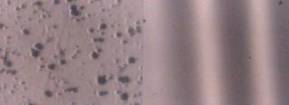
Special illumination
shows phase retardation from Inkjet ink.
It would seem to me that an
Inkjet printed grating is a combination of a phase and an amplitude grating
depending on the opacity of the ink.
The Ronchigrams from it have the Ethereal quality typical of phase
gratings.
Below are Ronchigrams using
blank Inkjet transparency material aligned with various width slit sources. The
period of this material is close to 150 lp/inch.
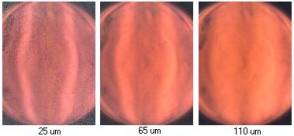
Blank commercial
Inkjet transparency Phase grating material with Slit.
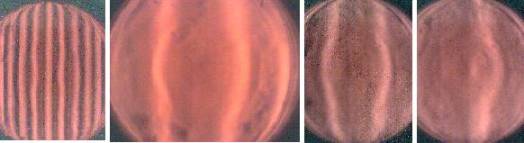
It is obvious that this
technique has much to offer if satisfactory gratings are available.
Unfortunately, the material
used to make these photographs seems to no longer be available. All of the newer transparency material
intended for Inkjet transparencies have a stipple finish instead of the
necessary surface striations. I do have
some of the original material left over but it is easily damaged by handling
and deteriorates quickly when exposed to humidity and dust. This would not matter if it were cheap and
common as was the original material.
Maybe some other common
type of film will become available to take its place. I keep looking at all types of films, tapes and membranes and
have found no replacement.
Bleached Photographic
Film Gratings.
Routine photographic
methods can also be used to make Phase gratings.
The Ronchigram below is of
an almost perfect sphere taken with a grating made from Kodalith film,
processed in D9 developer, and subsequently bleached with Farmers reducer. The grating image on the film, being
transparent, is invisible to the naked eye.
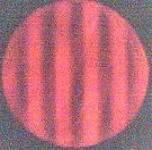
Bleached Film Grating
is about 200 lp/inch
While there would seem to
be no compelling reason to make gratings of this type, the above do show that
it is quite feasible. Of course,
amplitude gratings made in a similar way but left unbleached also work well. The main advantage of the Phase grating is
greater light throughput which may or may not be important.
GOTO RONCHI INDEX