RONCHI
History
1938 – 1945
GOTO RONCHI INDEX
Copyright – P. J.
Smith
But permission
is given to distribute this material in unaltered form as long as it is not
sold for profit.
More rational
analysis, a widening input
and new Serious Uses by Professionals
Towards the end of the 1930’s the Ronchi test had
become well enough established and respected that it was used by some advanced
amateurs and professionals for special advanced applications.
A few of these advanced amateurs were about to become
skilled professionals. The advent of
WW2 precipitated a huge expansion of the optics industry world wide, and personnel were required for advanced
development of new equipment and routine production of items. In countries with quite small optical
industries, but with a pool of optical expertise in the Amateur field it was
only natural for many to move into professional optics.
This was to continue even after WW2 as the cold war
developed and large US Avionics companies snapped up expertise from all over
the world.
Examples are Cox (later to write regularly in Sky and
Telescope), De Vany (later to work for Perkin Elmer and Hycon – the company
which made the cameras for the U2 spy plane - finally he had a regular column
in Applied Optics), Walard, and Lower.
In a similar way, many optical designers from areas as diverse as
Germany and Wales subsequently surfaced in countries such as Switzerland ( eg.
Bertele) and the US (eg. Herzeberger).
Funding, and being on the cutting edge of technology, has always been
attractive to researchers, and they readily moved to less dangerous and more
lucrative areas.
In many countries, ATMing activity and research was
seriously disrupted by WW2, but activity continued at a reasonable level in the
US. Some basic research continued in
Italy, although much was done in increasing isolation.
This was also true of other optical developments, for
example, Holland (eg. Bouwers), Russia
(eg. Maksutov), and France (Deve).
The following are
mainly from the Scientific American columns edited by Albert Ingalls.
More often, some of the most significant developments
were published in other prestigious scientific journals. Scientific American often reported on
extracts from these papers, but more and more the really serious ATM was
searching for really up to date and more detailed information than appeared in
Scientific American. Much of the
influence of Scientific American shifted to the published ATM books which were
essentially reprints of earlier Scientific American material. While extremely important, this precluded
some of the more up to date information.
Scientific American magazine still remained an
extremely important medium for dissemination information, so it is still a
fruitful source of research material.
This was to continue yet for some time until the era of the more specialist
publications such as Sky and Telescope which was in the near future.
1938. Ingalls, Scientific American, Jun
1938.
Ingalls reports on Kirkham’s use of a Ronchi grating when testing
eyepieces. This is extended to quantitative measurements of Spherical
aberration.
1939. Ingalls, Scientific American Apr 1939. Ingalls refers to the recognition of amateurs
such as H. A. Lower and Arthur De Vany by professionals. Their pioneering work on Schmidt
construction by Ronchi testing was behind this success.
1939 HW and LA Cox.
Journal of the British Astronomical Society. 50, 61-68, (1939). Placed a slit at the focus of a Schmidt and
observed the image by eye through the front.
He used a straight edge to aid interpretation and points out that this is
essentially the same as a method used by De Vany which used a square grid at
the focus of the Schmidt.
1939. R. Platzeck and E. Gaviola. JOSA. 29, 484,
(1939) "On the
Errors of Testing and a New Method of Surveying optical Surface and
Systems". While this has nothing
to do with Ronchi testing, it does indicate the push for new more rigorous
testing methods.
1939. Ingalls, Scientific
American Aug 1939. Ingalls reports on testing correcting
plates. Uses light beam on a small
silvered glass bead as pinhole.
1940. Ingalls, Scientific American, Dec
1940. Ingalls reports on people relying on
estimating shadows without zonal testing – resulting in poor mirrors.
1941. Ingalls, Scientific American, Jan
1941. Ingalls reports on testing a Wright corrector.
1941. Ingalls, Scientific American, Aug 1941. Ingalls reports on the difference between professionals and amateurs.
One tests at Centre of curvature, the other at focus using some null test. Each
considers the other peculiar.
1941. Ingalls, Scientific American, Aug, 1941. Ingalls reports
of a description by Eugene G. Brown of the Detroit
Astronomical Society of a reflection null for extremely short mirrors which is
now often called the Waineo Null test. Brown adds that Ralph Tozer of Detroit
is the first there who used the test described above.
Below is a diagram. The light is piped in via a Perspex (Lucite) rod. Being a null test, Ronchi lines should
appear straight. In a similar way, the
light pipe may supply light to a pinhole.
Today, small LED or Laser Diode sources make this less important. A variation is to use an extremely fine
fibre optic strand. The end may be
small enough to act as a pinhole without any attention or a glass ball may be
formed by melting the end. This assures
more even illumination.
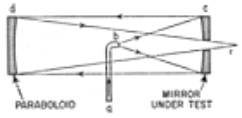
1941. Ingalls, Scientific American, Aug, 1941. Ingalls reports C.
M. Davenport and W. S. Bohlman uses piped-in light for testing both as a
pinhole and ronchi source.
1942. 1942. Ingalls, Scientific American, March 1942. Ingalls reports on Dr. Struve’s use of a Ronchigram for confirmation of progress in parabolizing very large observatory mirrors.
1942. Ingalls, Scientific American Apr, 1942. Ingalls reports of the
superb quality of the 82" mirror of the McDonald Observatory. The Ronchi test was one of many used.
1942. Ingalls,
Scientific American, May 1942. Ingalls reports on testing a
large corrector plate and the movement of amateurs into the ranks of
professionals such as Cox and McGuire.
1943. Ingalls, Scientific American, Jun 1942. Ingalls reports the use of a mercury sphere
as source during testing. Microscopists
had commonly used this as a testing source.
This technique was occasionally used by some pioneers of testing nearly
a century beforehand.
1943. Ingalls, Scientific American, Aug 1943. Ingalls reports on testing for turned down
edge comparing sensitivity of the Ronchi test.
1944. Ingalls,
Scientific American, May 1944. Ingalls reports on concave
grating mirrors used in a Fabry- Pérot interferometer which were supposedly
shown to be accurate to 1/50 wavelength by a Ronchigram. Some of these optics were for Neils Bohr.
Ingalls implies that 1/50 wavelength accuracy is possible of the test. This is quite tenuous and shows some lack of
understanding and rigour on his part.
Other Developments
1938. R. Crino. Ottica. 3, 304, (1938)
1938. R. Calamai. Ottica. 3, 41, (1938)
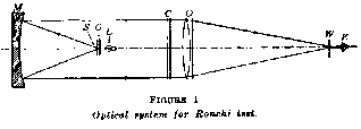
1938. R. L. Wallard. J. Sci. Instr. 15, 339, (1938) Made a Schmidt using a Slit at the focus as
a source which was re-imaged via a refractor through a Ronchi Grid made of 120
wires per inch. This is especially
about examining an unpolished surface smeared with oil. He went on to make a 30/36 inch Schmidt for
St. Andrews University, Scotland. Some testing was via an oil flat in
autocollimation when he used Grating/Grating.
Kirkham and others had earlier combined a viewing
telescope which received parallel light from an optik under test.
One part of the system contained the slit, the other
the grating. Wallard applied this to
the figuring of the corrector plate of a Schmidt correcting plate.
He also further developed an autocollimation test
using oil for the flat reflecting surface for both Newton and Cassegrain
variants.. Since there were many reflections
from unsilvered surfaces, he chose to use the grating/grating mode for maximum
light throughput.
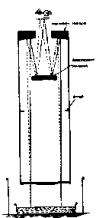
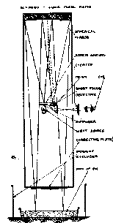
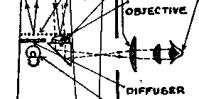
The above diagrams also show how he used a remote
viewing telescope to access the focal region.
1938 John Strong.
"Proceedings in Experimental Physics", p 77 - 78 Uses both Grating/Grating and Slit/Grating
variations depending on the optics under test.
This excellent publication, a Laboratory Manual, helped to spread
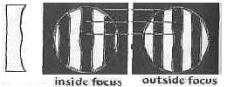
knowledge about Ronchi Testing. Unfortunately, some of the Ronchigrams in
some editions of this book have been transposed and are incorrect. The following is an example.
1938. HW and LA Cox.
Journal of the British Astronomicaql Society. 48, 308-313, (1938) "The Construction of a Schmidt
Camera". This describes
construction of a Schmidt camera. Used
a Slit and a Grating.
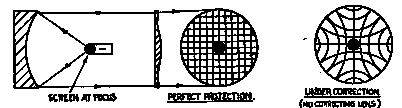
This is often called the Lower
test.
1939 HW and LA Cox.
Journal of the British Astronomical Society. 50, 61-68, (1939) Placed a slit at the focus of a Schmidt and
observed the image by eye through the front.
He used a straight edge to aid interpretation and points out that this
is essentially the same as a method used by De Vany which used a square grid at
the focus of the Schmidt.
1939. R. Platzeck and E. Gaviola. JOSA. 29, 484,
(1939) "On the
Errors of Testing and a New Method of Surveying optical Surface and
Systems"
1939. Di. Jorio. Ottica. 4, 31, (1939) Further developed physical model.
1939. Di. Jorio. Ottica. 4, 83, (1939) Further developed
physical model.
1939. E. Ricci. Ottica. 4, 104, (1939)
1939. B. Crino. Ottica. 4, 114, (1939)
1939. Di. Jorio. Ottica. 4, 184, (1939) Further developed
physical model.
1939. R. Bruscaglioni. Ottica. 4, 204, (1939) Investigation of
the sensitivity of the test.
1939. Di. Jorio. Ottica. 4, 254, (1939) Further developed
physical model.
1940. G. Bocchino. Ottica. 5, 219, (1940). Did research
on 5th order spherical aberration.
1940. V. Ronchi. Ottica. 5, 275, (1940)
1940. G. Bocchino. Ottica. 5, 286, (1940) Did research
on 5th order spherical aberration.
1940. V. Ronchi. Lezioni di Ottica Ondulatoria
(Zanichelli, Bologna), (1940) Investigation of the sensitivity of the
test.
1941. P. Pallitino. Ottica. 6, 26, (1941) Further developed
physical model.
1941. G. Toraldo di Francia. Ottica. 6, 151, (1941) Development and comparison of Geometric and
Physical models. He developed exact shape of fringes with wave theory.
1941. G. Toraldo di Francia. Ottica. 6, 258, (1941) Development and
comparison of Geometric and Physical models. He developed exact shape of
fringes with wave theory.
1942. Di. Jorio. Ottica. 7, 243, (1942) Further developed
physical model. He developed exact shape of fringes with wave theory.
1942. G. Toraldo di Francia. Ottica. 7, 282, (1942) Further developed
physical model. He developed exact shape of fringes with wave theory
1942. G. Toraldo di Francia. Ottica. 7, 304,
(1942) Attempts to apply
to chromatic aberration measurement.
1942. Di. Jorio. Ottica. 7, 314, (1942)
1943. G. Toraldo di Francia. Ottica. 8, 1, (1943) Further developed
physical model. He developed exact shape of fringes with wave theory.
1943. Di. Jorio. Ottica. 8, 92, (1943) .
1943. G. Toraldo di Francia. Ottica. 8, 225, (1943) Further developed physical model. He developed
exact shape of fringes with wave theory.
1943. Di. Jorio. Ottica. 8, 288, (1943) Further developed
physical model.
1943. G. Bocchino. Ottica. 8, 310, (1943)
1947. G. Toraldo di Francia. Atti. Fond. G. Ronchi 2,
25, (1947) Further
developed physical model. He developed exact shape of fringes with wave theory.
1947. G. Toraldo di Francia. Atti. Fond. G. Ronchi 2,
89, (1947)
1948. L. G. Schulz. JOSA. 38, 432, (1948) The name Ronchigrams was coined by
Schulz. Application to aspherics.
GOTO RONCHI INDEX